Have you ever considered how much your contribution to a workplace goes beyond the tasks
assigned to you?
Every successful workplace is built not only through completed assignments, targets, and
measurable results but also through several small contributions that often remain unnoticed.
Helping a colleague, sharing knowledge, solving a problem, taking responsibility,
maintaining discipline, and supporting your team during challenging situations are all
valuable contributions.
As employees, we should understand that our professional responsibilities do not end with
completing assigned tasks. The way we work, communicate, cooperate, and support others
also influences the overall working environment.
At times, the smallest actions can create the biggest positive impact.
Because not every valuable contribution is visible, but every valuable contribution
matters.
Completing your assigned responsibilities is important, but have you considered whether you
are also improving the way your work gets done?
There is a meaningful difference between finishing a task and making the process better. Both
are essential for individual growth and organisational success.
Your first responsibility is to understand your role, follow instructions, meet deadlines, and
deliver quality work.
When you consistently complete your responsibilities, you contribute to the smooth
functioning of your team and help maintain workflow stability.
Take ownership of your assignments, manage your time effectively, and ensure that your
work meets the expected standards.
Professional growth begins when you look beyond your assigned responsibilities and identify
opportunities to improve.
You can contribute by:
• Suggesting more efficient ways to complete assigned tasks.
• Identifying recurring mistakes and implementing effective solutions.
• Sharing knowledge and useful information with colleagues.
• Taking initiative to handle unexpected challenges.
• Improving team communication and coordination.
Do not limit yourself to asking, “Have I completed my task?”
Also ask, “Could I have done it better?”
That small change in thinking can make a meaningful difference in your professional
development.
Not every contribution receives immediate attention or appreciation. Some of the
most meaningful workplace efforts happen quietly, without recognition or expectation
of reward.
● You may help a colleague complete a difficult assignment, support another
department, resolve a minor issue, or take additional responsibility to keep work
moving smoothly.
● These actions may not appear in your performance reports, but they contribute to the
team’s overall success.
● Remember that your contribution should not be measured only by how visible your
work is or how frequently you receive appreciation.
● Focus on the quality of your efforts, the responsibilities you fulfil, and the positive
impact you create.
● At the same time, never hesitate to communicate your achievements and contributions
professionally. Making your work visible through proper updates and communication
helps others understand the value you bring.
Your everyday behaviour plays an important role in shaping the workplace environment.
Professionalism is not demonstrated only during meetings, presentations, or important
assignments. It is reflected in your daily actions.
Here are a few habits that can make a difference:
● Respectful Communication: Speak professionally, listen carefully, and respect
different opinions.
● Team Support: Be willing to help colleagues when they face challenges.
● Accountability: Take responsibility for your actions, commitments, and mistakes.
● Positive Initiative: Identify problems and suggest practical solutions instead of
simply pointing them out.
● Professional Discipline: Maintain punctuality, attendance, consistency, and
workplace conduct.
● Adaptability: Be open to feedback, learning, and changing work requirements.
Remember, your behaviour does not influence only your individual performance. It also
affects the people who work alongside you.

Every employee wants their efforts to be recognised and valued. However, recognition should
not depend only on visibility, communication, or individual achievements.
Your contribution includes both the work you complete and the positive impact you create
within your team.
When evaluating your own professional growth, consider the following:
1. Are you maintaining consistent work quality?
2. Are you taking ownership of your responsibilities?
3. Are you supporting your colleagues when required?
4. Are you communicating your progress and challenges effectively?
5. Are you showing initiative beyond routine assignments?
6. Are you contributing to a positive and professional working environment?
Do not compare your contribution with someone else’s visibility or recognition. Instead,
focus on improving your own performance and maintaining consistency.
A healthy workplace is one where genuine efforts are recognised fairly and every employee
gets an opportunity to grow.
Professional improvement does not always require major changes. Sometimes, a few minutes
of self reflection can help you understand your progress and identify areas for improvement.
We encourage you to spend five minutes at the end of each working day reflecting on these
questions:
1. Did I complete my responsibilities effectively today?
2. Did I help or support anyone in my team?
3. Did I identify or solve any workplace challenge?
4. Did my actions contribute positively to the working environment?
5. What can I improve tomorrow?
You do not need to write lengthy answers. Simply take a moment to evaluate your day
honestly.
Practising this regularly can help you develop self-awareness, accountability, and a
continuous improvement mindset.
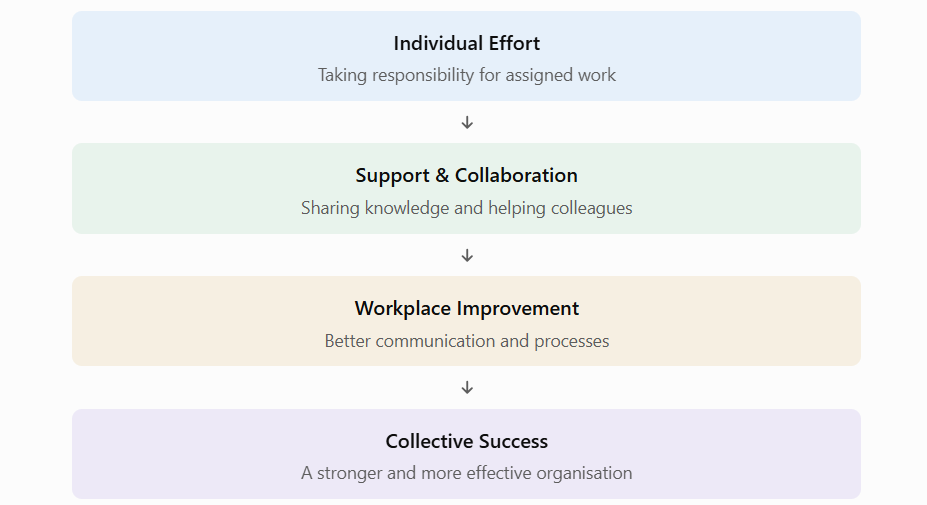
A successful workplace is not built through individual performance alone. It requires
cooperation, mutual respect, accountability, and shared responsibility.
As employees, each of us has a role in creating a productive and supportive working
environment.
Do not restrict your contribution to your department or assigned responsibilities when your
support can help the wider team. Share knowledge, communicate openly, respect your
colleagues, and take responsibility for the work entrusted to you.
When you notice a problem, think about how you can help improve the situation. When a
colleague needs support, contribute wherever possible. When you receive feedback, use it as
an opportunity to learn.
We encourage everyone to remember that workplace success is a collective effort. Your
individual contribution may seem small, but when combined with the efforts of others, it can
create meaningful results.
The strength of a workplace is not determined by one person’s contribution, but by how every
contribution comes together.
Your professional contribution is much more than the tasks you complete each day.
It is reflected in the responsibility you take, the support you offer, the problems you solve, the
discipline you maintain, and the positive influence you create around you.
As you move forward in your professional journey, do not focus only on completing your
assignments. Focus on improving your work, supporting your team, accepting responsibility,
and becoming someone who creates value beyond assigned duties.
We encourage you to recognise the importance of your everyday actions and continue
developing habits that contribute to both personal growth and workplace success.
Because beyond every successful result, there is always work that deserves to be seen.