Follow us

THE HIDDEN RISK OF SCALING MARKETING WITHOUT UNDERSTANDING CONSUMER DEMAND

Ayisha Sidhiqa S May 25, 2026

INTRODUCTION

In today’s rapidly evolving D2C ecosystem, many brands assume that aggressive marketing automatically leads to sustainable growth. With easier access to performance advertising, influencer collaborations, and digital acquisition channels, businesses often prioritize scaling campaigns before validating whether real consumer demand actually exists in the market. On the surface, rising impressions, traffic, and engagement create the appearance of momentum, but beneath these numbers lies one of the biggest structural risks in modern D2C growth—brands are scaling visibility before understanding consumer intent, purchase behavior, and market demand.


The reality is that marketing can amplify attention, but it cannot permanently create demand if the underlying consumer need and product relevance are weak. This is where Market Research Services, Customer Insights & Consumer Behavior Analysis, and Market Intelligence & Strategic Insights become critical. Without structured demand validation, brands often mistake engagement for buying intent and visibility for long-term scalability. As competition intensifies across digital platforms, businesses that fail to understand actual consumer demand before scaling acquisition spend often experience rising CAC, weak conversion efficiency, and unsustainable growth models.

Table of Contents

THE MODERN D2C GROWTH TRAP

The rise of digital advertising has made growth appear faster and more accessible than ever before. Platforms like Meta, Google, YouTube, and influencer ecosystems allow brands to reach millions of consumers instantly, leading many businesses to believe that increased visibility naturally translates into increased demand. However, higher reach does not always mean stronger consumer intent.


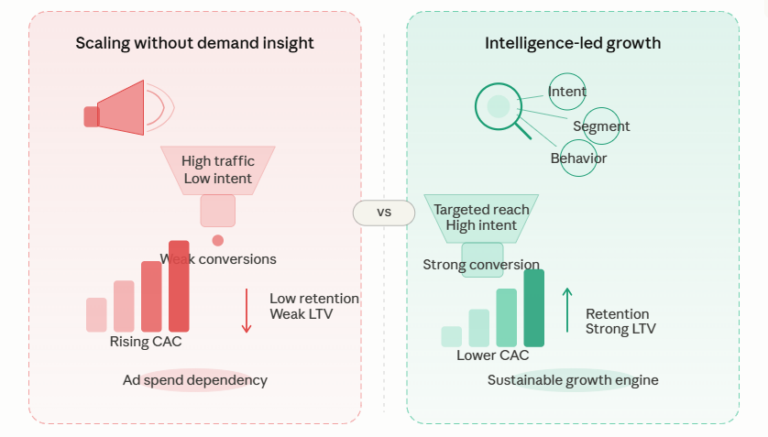
Many D2C brands launch with strong creative campaigns, influencer partnerships, aggressive advertising budgets, and marketplace visibility strategies. While these efforts may initially generate traffic and engagement, many businesses continue struggling with weak conversions, rising acquisition costs, and low repeat purchase behavior. This happens because marketing execution is often prioritized before understanding whether consumers genuinely need the product, connect with the positioning, or perceive enough long-term value to sustain repeat demand.


As a result, brands become increasingly dependent on paid advertising to maintain revenue momentum. Instead of building organic demand ecosystems, they enter a cycle where growth becomes directly tied to continuous ad spending. This is where Customer Insights & Consumer Behavior Analysis becomes essential, as sustainable growth depends not only on reaching consumers, but on understanding how they discover products, what influences trust, and what actually drives purchase decisions.

THE CORE PROBLEM: MARKETING BEFORE MARKET UNDERSTANDING

One of the most common strategic mistakes in D2C scaling is assuming that marketing can create demand regardless of market readiness. In reality, advertising performs best when it amplifies existing consumer interest rather than attempting to force demand into the market. Without proper market research and demand validation frameworks, brands often fail to identify:


  • Whether genuine market demand exists
  • Which audience segments are most relevant
  • What emotional triggers influence purchase decisions
  • Which channels build trust and conversion
  • How competitive the category already is
  • Whether pricing aligns with consumer expectations


Because of this, many brands scale campaigns based on assumptions instead of validated consumer intelligence. Over time, this creates operational inefficiencies where acquisition spend increases while conversion efficiency gradually declines. The issue is not always weak marketing—it is often the absence of Product Market Fit & Market Validation before scaling growth investments.

THE DIFFERENCE BETWEEN ATTENTION AND DEMAND

One of the biggest misconceptions in digital commerce is the belief that attention automatically equals demand. High engagement, viral reels, strong reach, and increased website traffic may create the impression of strong market acceptance, but consumer attention does not always indicate purchase intent.


Consumers frequently engage with:


  • Trend-driven content
  • Influencer collaborations
  • Visually appealing campaigns
  • Entertaining social media content


without having any real intention to purchase. This creates a dangerous scenario where brands optimize for vanity metrics instead of demand quality. A campaign may generate millions of views while still delivering weak conversion performance and low customer retention. This is why Demand Analysis and Consumer Intent Research have become essential in modern D2C growth planning. Brands must understand which engagement signals indicate genuine purchase readiness and which audience segments have long-term retention potential. Without these insights, businesses risk overestimating market demand and scaling inefficiently.

THE FINANCIAL IMPACT OF SCALING WITHOUT DEMAND VALIDATION

When marketing investment grows faster than consumer demand understanding, financial and operational inefficiencies begin compounding across the business. Rising customer acquisition costs, weaker ROAS, poor retention, and discount dependency become increasingly common.


Many brands experience:


  • Higher CAC across paid channels
  • Lower conversion efficiency
  • Weak repeat purchase behavior
  • Inventory planning inefficiencies
  • Reduced profitability despite revenue growth
  • Overdependence on performance marketing


Over time, businesses reach a stage where advertising spend becomes necessary simply to maintain existing sales levels. Instead of building sustainable consumer demand, the business becomes trapped in a cycle of continuous paid acquisition.

This is where Data Analytics & Business Intelligence (BI) becomes increasingly important. Businesses need visibility into conversion quality, customer lifetime value, attribution efficiency, and retention behavior in order to make informed scaling decisions rather than reactive marketing decisions.

CONCLUSION

The hidden risk in modern D2C growth is not weak marketing execution—it is scaling marketing before understanding whether sustainable consumer demand actually exists. Advertising can accelerate visibility, but it cannot permanently solve weak product-market fit, poor positioning, misaligned targeting, or lack of consumer relevance. As digital competition continues to intensify, businesses relying solely on acquisition spend will increasingly struggle with rising CAC and declining efficiency.


In contrast, brands integrating Market Research Services, Customer Insights & Consumer Behavior Analysis, and Data Analytics & Business Intelligence (BI) into their growth strategy will be far better positioned to build scalable, profitable, and resilient consumer ecosystems. The future of D2C growth will not belong to the brands spending the most on marketing—it will belong to the brands understanding consumer demand the best.