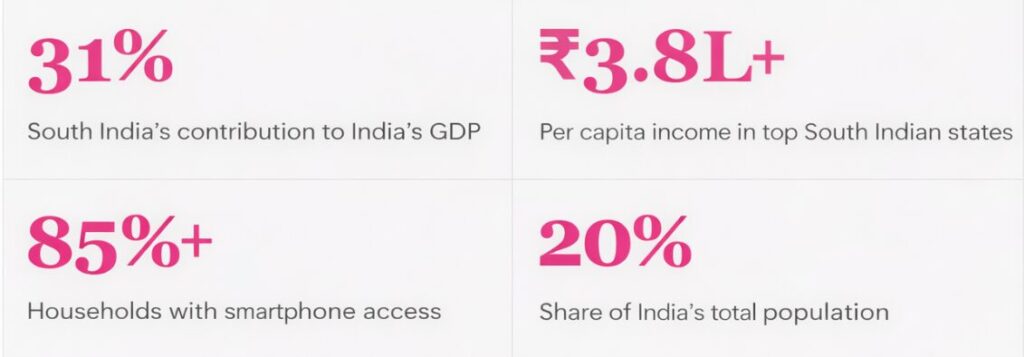
South India, with its blend of tradition and modernity, is one of India’s most dynamic consumer markets today. Covering Andhra Pradesh, Telangana, Karnataka, Tamil Nadu, Kerala, Puducherry, and Lakshadweep, the region combines cultural depth with strong economic momentum. With nearly 300 million people about 20% of India’s population it offers both scale and a rapidly evolving consumer base.
This blog explores key aspects of the South Indian consumer, including demographics, purchasing power, spending behavior, and youth influence, highlighting why the region is becoming central to India’s growth story.
“South India’s growth is not emerging it is already established, backed by strong economic contribution, digital penetration, and a steadily expanding consumer base.”
South India’s demographic advantage is one of its strongest growth drivers. The region is known for its high literacy rates and a deeply skilled, tech-enabled workforce. Kerala, for instance, boasts literacy levels exceeding 93%, significantly above the national average. This educational strength translates into a workforce that is both adaptable and future-ready, particularly in urban hubs such as Bengaluru, Hyderabad, and Chennai, which have become synonymous with India’s IT and technology leadership.
Equally important is the region’s youthful population. With a significant share of people under the age of 35, South India is powered by a demographic that is highly aspirational, digitally aware, and open to change. This younger audience is not just consuming more, but consuming differently
From an economic standpoint, South India consistently ranks among the strongest regions in terms of purchasing power. States like Telangana, Karnataka, and Tamil Nadu feature among India’s top performers in per capita income, supported by thriving industrial, IT, and service sectors. Urban centers such as Bengaluru and Chennai reflect this affluence clearly, where consumers are moving beyond essential spending and actively investing in premium lifestyles.
This shift is visible in how consumers spend. There is a clear movement toward aspirational and wellness-oriented consumption. High-end gadgets, smart home appliances, and premium vehicles are no longer niche purchases but increasingly mainstream among urban consumers. At the same time, health and wellness have emerged as major priorities. From fitness memberships and yoga practices to organic food and preventive healthcare, consumers are demonstrating a growing willingness to invest in long-term well-being. Kerala’s rise as a global hub for wellness tourism further reinforces this trend.
Lifestyle-driven categories are also witnessing strong momentum. Fashion, beauty, and home décor are expanding rapidly, particularly among younger audiences. E-commerce platforms have played a critical role in enabling this shift, offering convenience, personalization, and access to a wider range of products than ever before. As a result, South India has become a key growth market for digital-first and D2C brands.
“South Indian consumers are not just spending more they are spending with clear intent, prioritizing value, wellness, and meaningful experiences over mere consumption, reflecting a shift toward more conscious and purpose driven lifestyles.”
At the same time, the region presents a nuanced rural-urban dynamic. Rural economies, largely driven by agriculture, continue to play a foundational role, especially in states like Andhra Pradesh and Telangana. However, rural consumption is no longer static. Increased smartphone penetration, improved connectivity, and the rise of digital payments have begun to reshape purchasing behavior in these markets. Consumers in rural and semi-urban areas now have greater access to online platforms, enabling them to participate more actively in broader consumption trends.
Urban markets, on the other hand, continue to be driven by technology and service industries. Bengaluru’s position as India’s “Silicon Valley,” along with Chennai and Hyderabad’s contributions to automobiles, pharmaceuticals, and media, has created a consumer base with higher disposable incomes and evolving lifestyle expectations. What is particularly significant is how infrastructure and digital connectivity are increasingly bridging the rural-urban divide, allowing consumption patterns to diffuse more rapidly across regions.

At the center of this transformation is South India’s youth. This segment is not only driving demand but also redefining it through distinct behavioral shifts:
This generation is also redefining priorities in everyday life:
Brands that align with these evolving values and offer meaningful, experience-led solutions are more likely to build long-term loyalty within this segment.
For businesses, the implications are clear. South India is not a uniform market, and success here requires a deep understanding of its cultural, linguistic, and behavioral nuances. Localization is no longer optional but essential. Communication strategies must go beyond translation and genuinely reflect regional identities. Digital platforms offer powerful access, but their effectiveness depends on how well brands adapt to local contexts. Additionally, the growing importance of health, wellness, and sustainability presents new avenues for differentiation and growth.
Ultimately, the South Indian consumer represents a powerful intersection of tradition and modern aspiration. From the innovation hubs of Bengaluru to the cultural depth of Chennai and the wellness ecosystems of Kerala, the region offers a diverse yet connected landscape of opportunity. Businesses that take the time to understand this complexity and adapt their strategies accordingly will not only succeed in the region but also build a strong foundation for long-term growth.
South India is no longer just a regional market to be addressed—it is a strategic priority to be understood.
South India is a key consumer market due to its large population, strong economic performance, and a unique mix of tradition and modern consumption behavior, making it highly attractive for businesses.
Consumer growth in South India is driven by high literacy rates, a skilled workforce, increasing digital adoption, and a young population with rising aspirations and spending capacity.
South India has strong purchasing power, with states like Karnataka, Telangana, and Tamil Nadu ranking high in per capita income and supporting increased premium and discretionary spending.
Consumers are increasingly spending on aspirational products, lifestyle upgrades, and wellness-focused categories such as fitness, organic food, and preventive healthcare.
Digital adoption is transforming consumer behavior by enabling access to e-commerce, fintech, and digital services, even in semi-urban and rural areas.