Follow us

The Rise of Quick Commerce in 2026: How AI & Market Basket Analysis Are Reshaping Instant Buying Behavior

Sri Aruna Jothi N April 17, 2026

The retail landscape is undergoing a significant transformation with the rapid rise of quick commerce and data-driven technologies. This blog examines how Artificial Intelligence (AI) and Market Basket Analysis are enabling businesses to move beyond traditional selling approaches toward predictive and highly personalized customer experiences—an approach actively embraced by Studio Forge in driving digital innovation. It highlights how dark stores, real-time data, and self-learning recommendation systems are working together to anticipate consumer needs and influence purchase decisions.

By combining speed with intelligent insights, modern retail platforms, including forward-thinking, are redefining convenience, engagement, and customer loyalty. This overview sets the stage for understanding how technology is not just supporting retail—but actively reshaping consumer behavior and the future of buying.

In This Article

What if a platform knew you needed milk before you did?

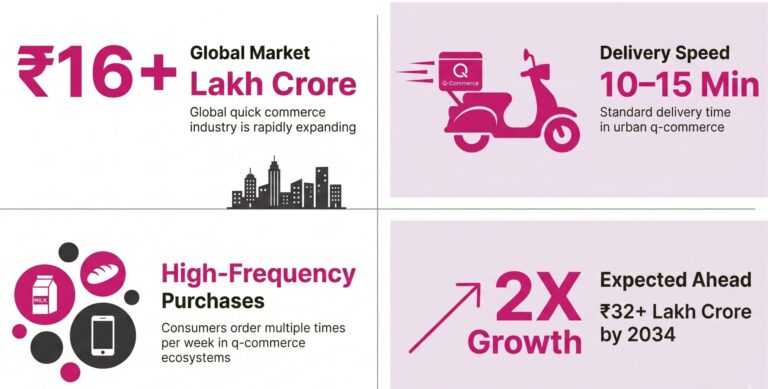
In 2026, this is no longer a question of possibility — it’s a built-in product capability. Quick commerce (q-commerce) has rapidly evolved from a pandemic-driven convenience into a ₹16+ Lakh Crore global industry, fundamentally reshaping how consumers discover and purchase products. At the core of this transformation lies a surprisingly enduring concept: market basket analysis. What was once a retrospective tool used to identify purchase patterns has now been supercharged by AI, enabling real-time, hyper-personalized recommendations. By continuously learning from live behavioural signals — such as browsing patterns, time of day, location, and even micro-interactions — q-commerce platforms are no longer just fulfilling demand, but actively shaping it. This fusion of classical analytics with advanced AI is turning every digital basket into a dynamic, predictive engine for consumer engagement and revenue growth.

What Exactly Is Quick Commerce in 2026?

Quick commerce isn’t just fast delivery. It is an entirely reimagined retail model — one where the warehouse is your neighbour, the picker is an algorithm, and the journey from “I want it” to “I have it” is measured in single-digit minutes rather than days.

At its core, q-commerce operates through a network of dark stores — micro-fulfilment centres positioned within 2–3 km of dense residential clusters. These aren’t your average warehouses. They’re AI-curated stock environments where every SKU placement is determined by predictive analytics, local demand modelling, and weather-correlated purchase patterns.

In India alone, players like Blinkit, Zepto, and Swiggy Instamart now collectively handle over 8 million daily orders, with average delivery times hovering at 12 minutes across major metros. Globally, the playbook is near-identical — and the data science sitting beneath the surface is where the real story lives.

Market Basket Analysis: From Supermarket Shelves to Neural Networks

Market basket analysis (MBA) has existed since the 1990s, famously applied when a supermarket chain discovered that customers who bought diapers on Friday evenings were statistically likely to buy beer in the same trip. The insight was pure gold — product placement changed, revenue climbed.

In 2026, the technique has been reinvented from the ground up. Classical association rule mining (Apriori, FP-Growth) has given way to deep learning models that simultaneously analyse hundreds of variables: time of day, local weather, live sports events, social trending topics, user’s meal plan subscriptions, recent app scrolling behaviour, and even predicted mood states inferred from typing patterns.

Modern market basket analysis doesn't just find what people buy together — it predicts what they haven't bought yet, why they need it, and when to surface it to trigger a frictionless decision.

The Association Rule Has Evolved

Where traditional MBA generated rules like “customers who buy bread also buy butter (confidence: 78%)”, today’s AI-MBA systems produce contextual, session-aware recommendations that account for:

AI-Driven Hyper-Personalisation: The 3 Layers

In 2026, delivery speed is no longer the competitive edge in quick commerce — intelligence is. Leading q-commerce platforms are redefining customer experience through advanced AI personalisation, creating smarter, more intuitive shopping journeys. This transformation operates across three powerful layers: session intelligence, behavioural memory, and predictive intelligence.

At the first level, session intelligence activates instantly when a user opens the app. It analyses real-time signals such as time of day, location, browsing patterns, and product interactions to deliver context-aware recommendations. Instead of static product listings, users experience dynamic prompts like “Quick dinner tonight?” or “Restocking essentials?” — turning browsing into guided discovery.

The second layer, behavioural memory, builds long-term customer understanding. Platforms track recurring purchase cycles, preferences, and subtle habit changes — such as switching product sizes or late-night snacking patterns. This enables perfectly timed nudges like “Running low?” that align with individual consumption behaviour, increasing both convenience and conversion.

Finally, predictive intelligence takes personalisation a step further by anticipating customer needs before they arise. By integrating external data sources like weather patterns, local events, and social trends, AI proactively suggests relevant products. For example, on a rainy evening, users might see soup ingredients or comfort food recommendations — even before they begin searching.

Together, these three layers form the intelligence backbone of modern q-commerce platforms, shifting the focus from fast delivery to deeply personalised, data-driven customer experiences that drive engagement, loyalty, and revenue.

Dark Stores & Demand Forecasting: The Invisible Infrastructure

The physical backbone of q-commerce — dark stores — are only as effective as the AI forecasting models that govern their inventory. Unlike a supermarket that stocks based on weekly purchase orders, dark stores operate on dynamic, rolling 24-hour stock models that re-evaluate SKU allocations every few hours based on live signals.

Modern dark store AI considers factors that would have been impossible to model five years ago: a Bollywood film releasing on a Friday (popcorn + drinks spike), a cricket match starting at 7pm (salty snacks + energy drinks surge), or a viral social media recipe (a specific brand of tahini selling out within 90 minutes of the video trending).

Leading dark stores in 2026 achieve 94–97% in-stock accuracy on top-200 SKUs because the AI doesn't wait for stock-outs — it pre-positions inventory before demand materialises.

How This Is Changing Consumer Psychology

The implications for consumer psychology are profound and, frankly, worth examining with honesty as well as enthusiasm. When an AI platform accurately predicts your needs 8 out of 10 times, it creates a new kind of dependency — one built on the expectation of frictionless fulfilment.

Consumer research in early 2026 shows three significant behavioural shifts emerging:

The Collapse of the Consideration Phase

Traditional purchase funnels — Awareness → Consideration → Intent → Purchase — have collapsed in q-commerce contexts. AI recommendations arrive at the moment of peak receptivity, and the low-friction UX (one-tap add, 30-second checkout) means the “consideration” phase lasts seconds, not days. For everyday essentials, consumers have effectively delegated consideration to the algorithm.

The Basket Expansion Effect

AI-driven cross-sell isn’t subtle. When the app suggests “customers who bought this also ordered X”, it is drawing on basket analysis involving millions of similar orders. The result? Average basket sizes have grown 3.2x compared to pre-AI recommendation baselines. Consumers regularly add 2–4 items they hadn’t consciously intended to buy — and most report satisfaction with those additions.

The Rise of “Ambient Commerce”

Perhaps the most striking shift is the emergence of ambient commerce — a mode where purchasing is no longer a deliberate act but a background process. Subscription-based auto-replenishment, AI-triggered smart home orders (a connected fridge notifying the q-commerce app when milk drops below a threshold), and predictive bundle dispatches are turning commerce into something closer to a utility than a shopping experience.

The Challenges Nobody Talks About

No transformation of this scale comes without friction. Three significant challenges are surfacing across the q-commerce landscape in 2026, and they deserve candid attention.

Data Privacy and Inference Creep

The richer the personalisation, the richer the data infrastructure required. Q-commerce platforms are now inferring sensitive personal attributes — dietary conditions, household income proxies, relationship status, even pregnancy — from purchase patterns with alarming accuracy. Regulatory frameworks in India (DPDP Act 2025) and the EU (AI Act enforcement) are beginning to impose guardrails, but enforcement remains nascent.

The Dark Side of Recommendation Loops

AI systems optimising for basket size can inadvertently create unhealthy purchasing loops — surfacing high-margin, high-calorie comfort foods during stress signals, or nudging premium SKUs when price-sensitive users are already stretching budgets. Responsible AI in commerce means optimising for long-term customer health and trust, not just short-term GMV.

Last-Mile Worker Economics

The human delivering in 10 minutes is often the one absorbing the most operational pressure. Algorithmic route optimisation can push delivery personnel into unrealistic time targets. As q-commerce scales, the industry is confronting a fundamental question: can the economics be humane and profitable simultaneously?

What Comes Next

Quick commerce in 2026 is proof that when logistics infrastructure meets advanced data science, the result isn’t just speed — it’s a wholesale reimagining of what it means to buy something. Market basket analysis, once a neat party trick in a supermarket analytics deck, has evolved into the cognitive core of a multi-hundred-billion-dollar industry.

The next frontier? Fully autonomous dark stores with robotic pickers guided by AI, real-time nutrition-aware basket optimisation, and commerce interfaces embedded directly into voice assistants, smart glasses, and connected kitchen appliances. The basket is getting smarter — and so is the buying experience around it.

For brands operating in this space, the message is clear: the competitive moat in q-commerce is no longer built on delivery speed alone. It’s built on the quality, ethics, and depth of the intelligence layer. Who understands their customers better, predicts needs more accurately, and earns trust more consistently — that is the race that matters in 2026 and beyond.

Frequently Asked Questions

What is quick commerce (q-commerce)?

Quick commerce (q-commerce) refers to ultra-fast delivery services that promise to deliver groceries and essentials within 10 to 30 minutes through a network of hyper-local dark stores and AI-powered logistics. Unlike traditional e-commerce — which prioritises range and price — q-commerce prioritises speed and convenience, often at a premium.

AI enhances market basket analysis by processing millions of purchase patterns in real time to identify product affinities, predict what customers will buy next, personalise suggestions based on individual and cohort behaviour, and pre-position inventory in dark stores before demand spikes occur. Modern systems layer in weather, events, social signals, and cross-channel browsing data to achieve a level of predictive accuracy impossible with classical association rule mining.

Dark stores are small, purpose-built fulfilment centres located within residential neighbourhoods. They are not open to the public — they exist purely for picking and packing fast delivery orders. Their stock levels are determined by AI demand forecasts updated every few hours, allowing platforms to maintain high in-stock accuracy on the SKUs that matter most in a given zone.

In 2026, consumers are increasingly driven by impulse convenience. AI platforms anticipate needs and push contextual recommendations, collapsing the traditional purchase consideration cycle. Average basket sizes have grown 3.2× compared to pre-AI baselines. A new phenomenon — ambient commerce — is also emerging, where purchasing becomes a background, near-automatic process driven by subscriptions and smart home integrations.

Profitability remains the sector’s biggest debate. High delivery costs, dense fulfilment infrastructure, and aggressive customer acquisition spending have historically created losses. However, leading platforms in 2026 are nearing contribution margin positivity by combining AI-driven basket expansion (increasing revenue per order), smart SKU curation (reducing waste), and private label penetration (improving margins). Unit economics are improving, but scaling profitably remains an ongoing challenge.