
South India is witnessing a D2C gold rush.
Brands from Chennai, Bengaluru, Hyderabad, and Kochi are racking up impressive Instagram followers, hitting their first ₹10 lakh revenue months, and celebrating early traction. Founders post about their overnight growth. Investors notice. The press covers it.
But underneath those dopamine-hit dashboards, something more troubling is quietly building — a collapse waiting to happen.
The hard truth about D2C brand failure in India—especially South India—is that the signals of growth and the signals of impending collapse often look identical from the outside. Spiraling customer acquisition costs. Falling repeat orders. Plateauing revenue after month 14. A product-market fit that worked in Chennai but broke in Coimbatore.
Growth looks strong. But collapse is hidden until it isn’t.
This article is for founders, brand managers, and marketers who are building D2C brands in South India and want to understand—before it’s too late—why so many of them don’t make it past scale. Whether you’re navigating the South India D2C market for the first time or trying to break through a D2C growth plateau, what follows is the clearest diagnosis available — and what you can do about it.
The Narrative vs. The Reality
The D2C business model in India is a compelling one. No middlemen. Direct customer relationships. Better margins. Full control over brand experience. And in South India, with its rising digital penetration, multilingual internet users, and a massive aspiring middle class, the opportunity feels enormous.
Tamil Nadu alone has over 8 crore internet users. Karnataka’s startup ecosystem is one of Asia’s most active. Kerala’s consumer base is digitally literate and brand-aware. Telangana and Andhra Pradesh are seeing explosive growth in Tier 2 e-commerce in South India.
The opportunity is real. But the execution gap is brutally wide.
Studies on D2C brand performance in India show that nearly 62% of D2C brands that cross the ₹1 crore revenue mark fail to scale beyond ₹5 crore within three years. They stall, burn through capital, and eventually collapse — not because the product was bad, but because the brand never truly understood its customer. This is one of the most consistent patterns in direct-to-consumer brand failure across Indian markets.
South India D2C growth amplifies this problem uniquely. It is not one market — it is five distinct cultural, linguistic, and behavioural markets layered on top of each other. A brand that thrives in Bengaluru’s tech-savvy consumer base may find zero resonance in Madurai’s price-sensitive, trust-dependent households. Regional consumer behaviour in South India is not a footnote — it is the entire game.
The solution is customer intelligence for D2C brands — and most South Indian brands are operating entirely without it.
The Numbers Behind D2C Brand Failures
Let’s not guess. Here’s what the data tells us about D2C brand failure in India — with specific implications for South India:
Customer Acquisition Cost is spiralling
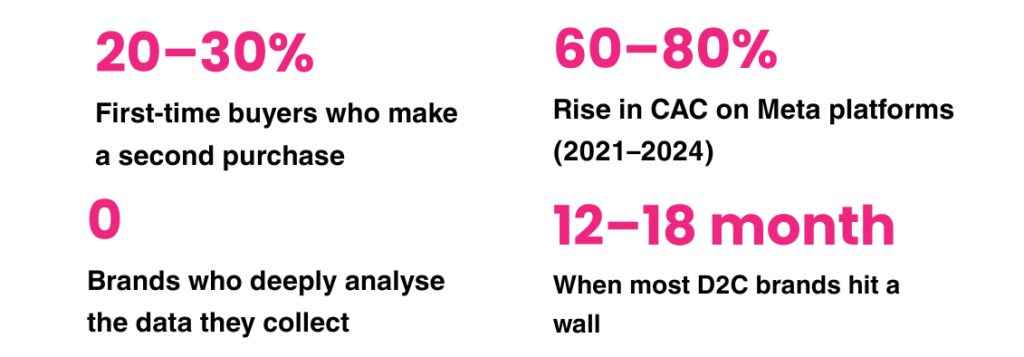
Between 2021 and 2024, average customer acquisition cost for D2C brands in India increased by over 60–80% on Meta platforms. In South India, where vernacular content and regional digital marketing are still underdeveloped, brands are competing on English-language performance ads that reach the wrong audience — and paying premium CPMs for it. Without vernacular targeting strategies, this inefficiency will only deepen.
Retention is the hidden killer
The average D2C brand retention rate in India sits at just 20–30% of first-time buyers making a second purchase. In South India, where word-of-mouth and community trust are critical buying triggers, a failure to build post-purchase loyalty has an outsized negative effect. Losing a customer here doesn’t just cost you that sale — it costs you their entire network. For D2C brands in Tamil Nadu, Karnataka, and Kerala, this community dimension makes retention not just a revenue metric — it is a brand survival metric.
The 12–18 month plateau is real
Most South Indian D2C brands experience strong initial traction — often built on founder reputation, initial PR, or viral social content — followed by a sharp D2C growth plateau between months 12 and 18. Revenue stops growing. Performance marketing costs rise. The founding team runs harder but gains less ground. This pattern is not unique to one category or one city — it is the most predictable failure arc in the South India D2C market.
The root cause: Lack of customer understanding
Across all of these data points, the underlying failure is the same: brands don’t know who their customer really is, what triggers their purchase, and what makes them leave. They know their revenue. They don’t know their customer journey.
Direct-to-consumer marketing was supposed to give brands unparalleled customer access. Instead, most brands collect the data — and never analyse it deeply enough to act on it. Without structured D2C customer journey mapping and consumer behaviour analysis, even the best product will eventually hit a wall it cannot see coming.
Short-term spikes driven by influencer activity, social media virality, or seasonal relevance are often misinterpreted as product-market fit.
In reality, virality represents a temporary distribution surge, not a reliable indicator of sustained demand. Brands that scale operations, marketing budgets, and inventory based on such spikes often face sharp corrections once the momentum fades.
Sustainable growth depends on consistently delivering value to a clearly defined customer segment — not on episodic visibility.
In metropolitan cities such as Bengaluru and Hyderabad, trust is primarily established through digital signals — including customer reviews, brand presence, user experience, and fulfillment efficiency.
However, in Tier 2 and Tier 3 markets such as Madurai, Kochi, and Mysuru, trust is significantly influenced by community validation, local networks, and offline familiarity.
A uniform, metro-centric marketing strategy fails to address these differences, resulting in low conversion rates and inefficient customer acquisition.
Consumer response to pricing varies significantly across regions. A price point that is perceived as acceptable in urban centers like Bengaluru may be viewed as premium or inaccessible in cities such as Coimbatore or smaller towns.
Pricing effectiveness is therefore not determined solely by affordability, but by contextual value perception.
Leading D2C brands address this by implementing differentiated pricing architectures — including trial packs, bundled offerings, and region-specific positioning — while maintaining product consistency.
The assumption that South India functions as a single, unified market is a strategic misstep.
States such as Tamil Nadu, Karnataka, Kerala, Andhra Pradesh, and Telangana each exhibit distinct cultural, linguistic, and economic characteristics.
Effective scaling requires granular market segmentation, taking into account regional preferences, consumption patterns, and cultural triggers, rather than relying on broad geographic assumptions.
A common growth-stage error among D2C brands is the expansion of advertising spend without a clear understanding of the customer journey.
Increased traffic does not inherently translate into improved conversions or retention. Without insights into how customers discover, evaluate, and engage with the brand, marketing investments become inefficient.
In South India, customer journeys are often influenced by regional content ecosystems, peer recommendations, and community validation, which differ significantly from standardized digital funnels.
Sustainable growth requires a structured approach to mapping and optimizing each stage of the customer journey.
“Viral moments test potential, not scale growth comes from how you use the data. What works in one market won’t in another, and without segmentation, brands miss high-ROAS audiences hiding within their own data.”
From Instinct to Intelligence
Studio Forge is a market research and customer intelligence firm that works specifically with growth-stage D2C brands in India. The work is not about strategy decks — it is about equipping brand leadership with the precise, regional, behavioural data needed to make better decisions faster.
In a market where D2C brand failure is often caused not by bad products but by poor customer understanding, Studio Forge exists to close that gap — permanently.
Customer Journey Mapping for D2C Brands
Studio Forge maps the full D2C purchase lifecycle — from awareness trigger to advocacy. This includes identifying the specific channels, content types, and trust signals for South Indian consumers at each stage, segmented by region and buyer persona. Brands stop guessing which touchpoints convert and start building journeys that are designed around how their actual customers think, search, and decide.
Regional Segmentation Research
Through primary research across Tamil Nadu, Karnataka, Kerala, Telangana, and Andhra Pradesh, Studio Forge builds regional consumer segment profiles that reflect actual on-ground behaviour — not national averages. Brands learn exactly where their strongest consumer clusters in South India are, what drives their purchase decisions, and how to reach them effectively without wasting ad spend on the wrong geographies.
Retention Analytics & Diagnostics
By analysing existing customer data, Studio Forge identifies where and why buyers are churning, what the highest-lifetime-value D2C customers look like, and what interventions — in product, communication, or experience — can meaningfully improve D2C customer retention rates. For most South Indian brands, this diagnosis alone reveals the single biggest lever for revenue growth they weren’t pulling.
D2C Pricing Research
Structured price sensitivity research across South Indian geographies allows brands to architect regional D2C pricing strategies that maximise conversion and margin simultaneously — across Bengaluru, Coimbatore, Hyderabad, Kochi, and every Tier 2 market in between. One price point rarely fits all. Studio Forge helps brands find the architecture that does.
Brand Audits for Regional Markets
Studio Forge evaluates how a brand is perceived across different South Indian regional markets — identifying trust gaps, communication misalignments, and positioning risks before they show up as declining revenue or rising CAC. A D2C brand audit of this kind is not a vanity exercise. It is a pre-scale diagnostic that tells you what your customer sees when your ad reaches them — and whether that perception is working for you or against you.
The firm’s positioning is simple: data-driven decision intelligence for D2C brands that want to scale, not just grow. Because in South India’s complex, multilingual, multi-behavioural consumer landscape, instinct alone has never been enough.
“D2C brands don’t fail because of bad products. They fail because they never deeply understood who was buying, why, and what would make them come back.”
“South India is not one market. Treating it as one is not a scaling strategy — it’s a speed limit.”
“Scaling ads without mapping the customer journey is not growth. It is expensive guessing.”
“The 12-month plateau is not a market problem. It’s a customer intelligence deficit showing up on a revenue chart.”
“Retention in South India is trust compounded over time. Brands that don’t earn it in the first purchase won’t get a second chance.”
If you’re building or running a D2C brand in South India, here is what needs to happen — specifically, concretely, and without delay:
The D2C model is not broken. But the way most South Indian D2C brands are operating it — on intuition, on viral momentum, on metro-centric assumptions — is.
South India is one of the most exciting consumer markets in the world. It is educated, aspirational, digitally connected, and deeply underserved by brands that actually understand it. The brands that take the time to build real customer intelligence will scale. The brands that don’t will plateau, wonder why their CAC keeps rising, and eventually become another cautionary statistic.
The complexity of South India is not a barrier. It is a competitive advantage for the brands willing to understand it.
Studio Forge exists for exactly that purpose — to help D2C brands replace expensive guesswork with precise, regional customer intelligence, and to turn South India’s complexity into their most powerful growth asset.
Most South Indian D2C brands achieve early traction through founder reputation, influencer moments, or viral content — but mistake that for product-market fit. The real collapse happens between months 12 and 18, when CAC rises, repeat purchase rates stay low, and the brand has no deep understanding of who its customer actually is or why they bought in the first place.
The average D2C brand in India retains only 20–30% of first-time buyers for a second purchase. For South Indian brands, where word-of-mouth and community trust are central buying triggers, low retention has an outsized effect — losing one customer often means losing their entire network.
Between 2021 and 2024, average CAC on Meta platforms increased by 60–80% for D2C brands in India. In South India, this is compounded by underdeveloped vernacular targeting, which means brands pay premium CPMs to reach audiences that were never the right fit.
South India is five distinct cultural, linguistic, and behavioural markets — Tamil Nadu, Karnataka, Kerala, Andhra Pradesh, and Telangana — each with different languages, trust signals, price perceptions, festival calendars, and buying triggers. A strategy built for Bengaluru’s metro consumer will often fail completely in Madurai, Mysuru, or Warangal.
Studio Forge is a market research and customer intelligence firm that helps D2C brands operating in South India replace expensive guesswork with precise, regional, behavioural data. Services include customer journey mapping, regional segmentation research, retention diagnostics, pricing sensitivity studies, and brand audits — all focused on helping brands make better growth decisions faster.