Follow us

B2B vs B2C vs D2C: Choosing the Right Growth Model for Your Business

Kaaviya P April 20, 2026

In today’s rapidly evolving market landscape, one of the most critical strategic decisions a business must make is where and how to sell. The choice between B2B (Business-to-Business), B2C (Business-to-Consumer), and D2C (Direct-to-Consumer) is no longer just a structural decision—it directly impacts profitability, scalability, customer relationships, and long-term brand control.

At a time when digital transformation, customer expectations, and competition are all intensifying, selecting the right model is not optional. It is foundational.

This blog breaks down each model, supported by market data, and helps you determine where your business should sell in 2026 and beyond.

Before choosing the right path, clarity is essential.

B2B (Business-to-Business): Selling products or services to other businesses

B2C (Business-to-Consumer): Selling directly to end consumers via retailers or platforms

D2C (Direct-to-Consumer): Selling directly to customers without intermediaries

While these models may seem straightforward, their implications on pricing, marketing, operations, and scalability are significantly different.

Table of Contents

Market Size & Growth Data (2026 Outlook)

Understanding market trends helps ground your decision in reality:

  • Global B2B eCommerce market is projected to exceed ₹3,000 trillion by 2026, driven by digital procurement and enterprise tech adoption
  • B2C eCommerce market is expected to reach ₹620 trillionglobally
  • D2C brands are growing at ~15–20% CAGR, significantly faster than traditional retail

In India specifically:

  • B2B accounts for over 80% of total commerce value
  • D2C brands have crossed 800+ active brands, expected to hit ₹7 lakh crore market size by 2030

B2B: When and Why It Works

B2B is the backbone of large-scale, stable revenue businesses.

When B2B Makes Sense

  • Your product solves a specific business problem
  • You have high-ticket offerings
  • Sales require customization or consultation
  • You prefer long-term contracts over quick sales

Key Characteristics

  • Longer sales cycles (3–12 months)
  • Fewer but higher-value customers
  • Relationship-driven growth

Data Insight

Challenge

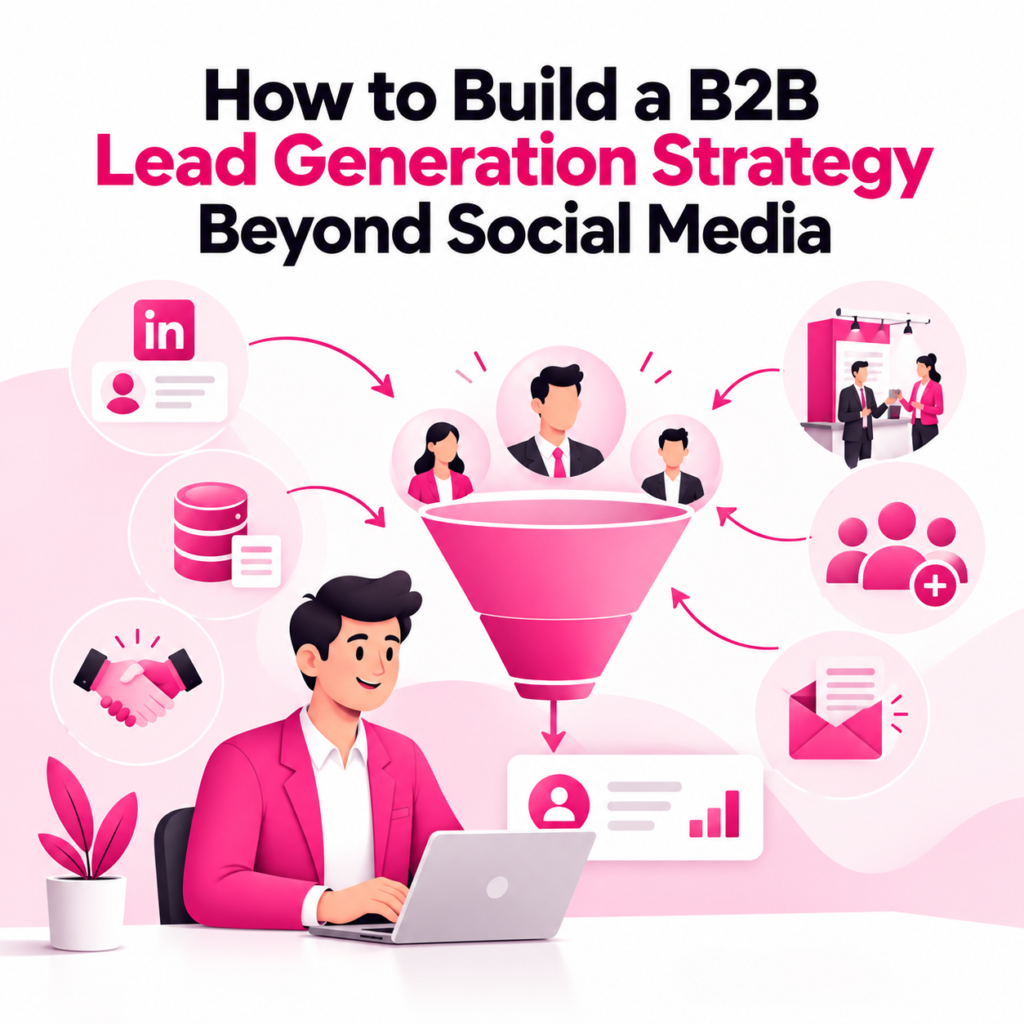
Scaling B2B requires precision, not volume. Lead quality matters more than lead quantity.

B2C: Scale Through Emotion and Reach

B2C is built for mass reach and fast transactions.

When B2C Makes Sense

  • Your product has broad appeal
  • Price points are relatively low to mid-range
  • Purchase decisions are emotion-driven
  • You rely on volume for revenue

Key Characteristics

  • Short buying cycles
  • High competition
  • Heavy reliance on marketing and branding

Data Insight

  • 73% of consumers say experience influences purchase decisions
  • Brands investing in personalization see 40% higher revenue growth

Challenge

Customer acquisition costs (CAC) are rising sharply, making profitability harder without strong differentiation.

D2C: Control, Margins, and Brand Power

D2C is the fastest-growing model—and for good reason.

When D2C Makes Sense

  • You want full control over branding and pricing
  • You aim to build direct customer relationships
  • You rely on repeat purchases and loyalty
  • You want access to first-party customer data

Key Characteristics

  • No intermediaries
  • Higher margins (20–40% improvement vs traditional retail)
  • Strong dependence on digital channels

Data Insight

  • D2C brands reduce dependency on marketplaces by up to 60%
  • Brands with strong first-party data strategies see 2–3x better retention rates

Challenge

High upfront investment in marketing, logistics, and customer experience.

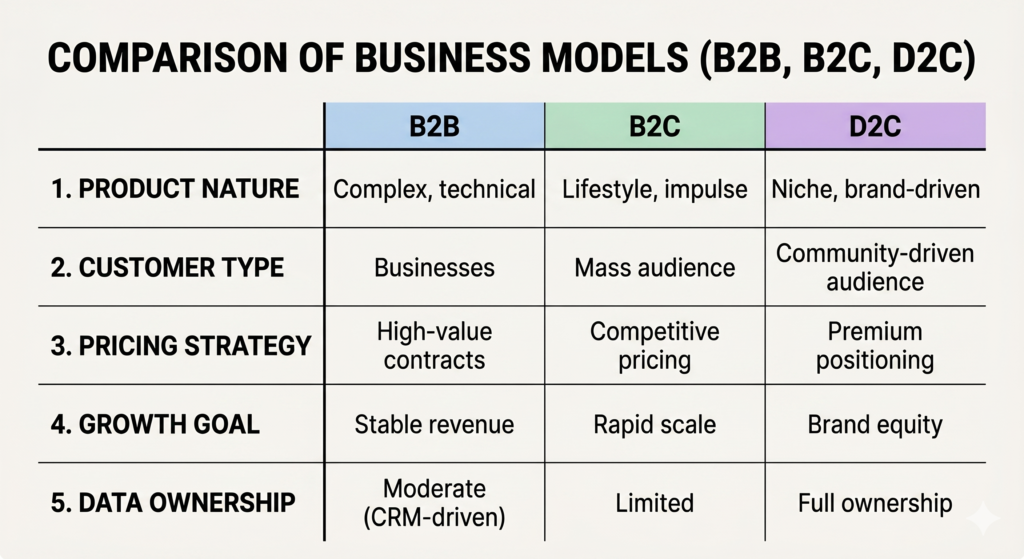
Key Factors to Decide Your Model

Choosing between B2B, B2C, and D2C depends on more than preference.

Hybrid Models: The Real Winner?

In 2026, the most successful companies are not choosing one—they are combining models.

Common Hybrid Strategies

  • B2B + D2C: Manufacturers selling to distributors and directly to customers
  • B2C + D2C: Brands using marketplaces for reach and D2C for margins
  • Full-stack model: Owning both enterprise and consumer channels

Data Insight

Companies using hybrid models report:

  • 30–50% higher revenue diversification
  • Lower risk during market fluctuations
  • Better customer insights across segments

Key Takeaways

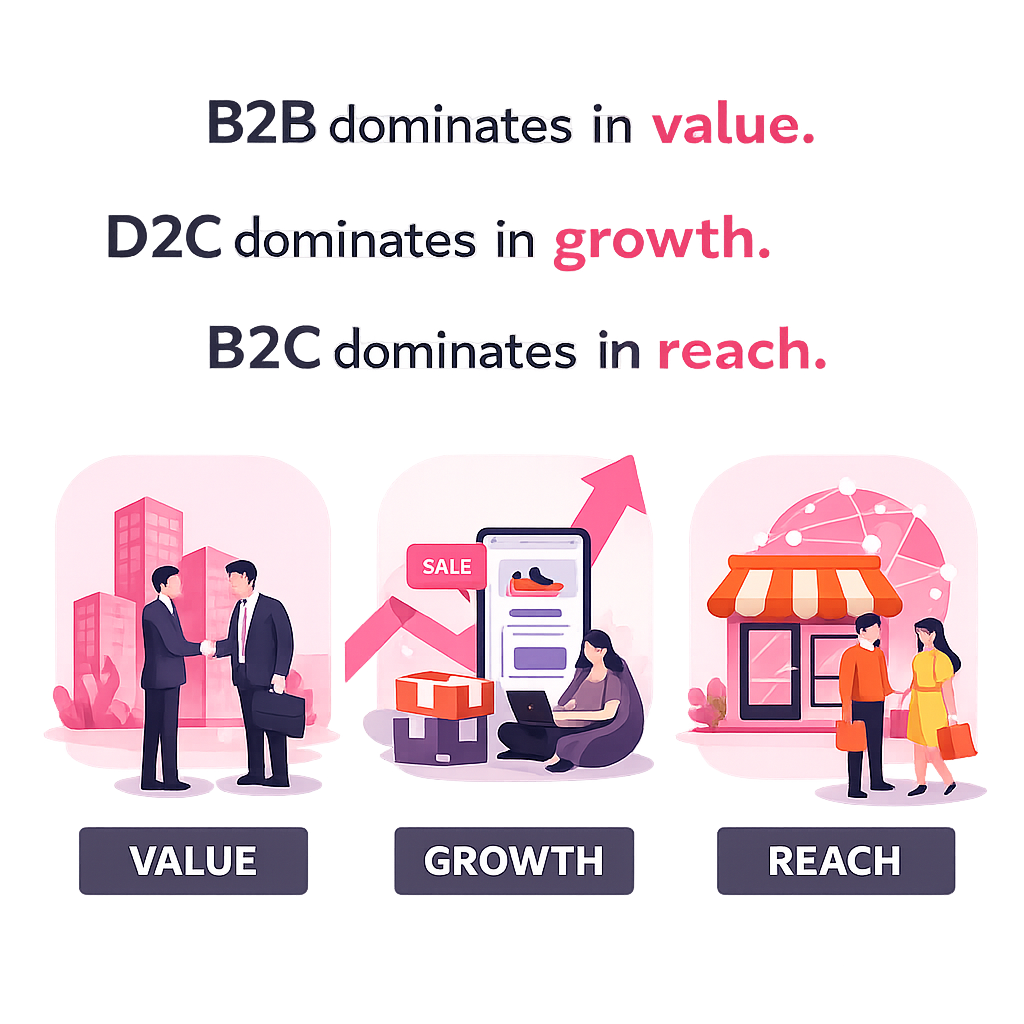
  • B2B drives high-value, stable revenue
  • B2C enables mass reach and fast scaling
  • D2C builds brand control and long-term profitability
  • The best strategy in 2026 is often not choosing one—but combining wisely

Your decision should align with:

  • Product type
  • Market demand
  • Customer behavior
  • Long-term vision

Conclusion

In studio forge we believe There is no universal answer to where you should sell—only a strategic one.

In 2026, success comes from alignment, not assumption. Businesses that understand their customers deeply, leverage data effectively, and choose the right go-to-market model will outperform those chasing trends blindly.

At its core, the decision between B2B, B2C, and D2C is about control vs scale vs stability.

The real question is not which model is better
It is which model is right for your business right now.

Frequently Asked Questions

1. Which model is most profitable?

It depends. B2B = high-value deals, B2C = volume sales, D2C = higher margins.

Yes. Many businesses use a mix (hybrid model) to grow faster and reduce risk.

No. Big brands also use D2C to control pricing and customer relationships.

Based on your product, customers, pricing, and business goals.